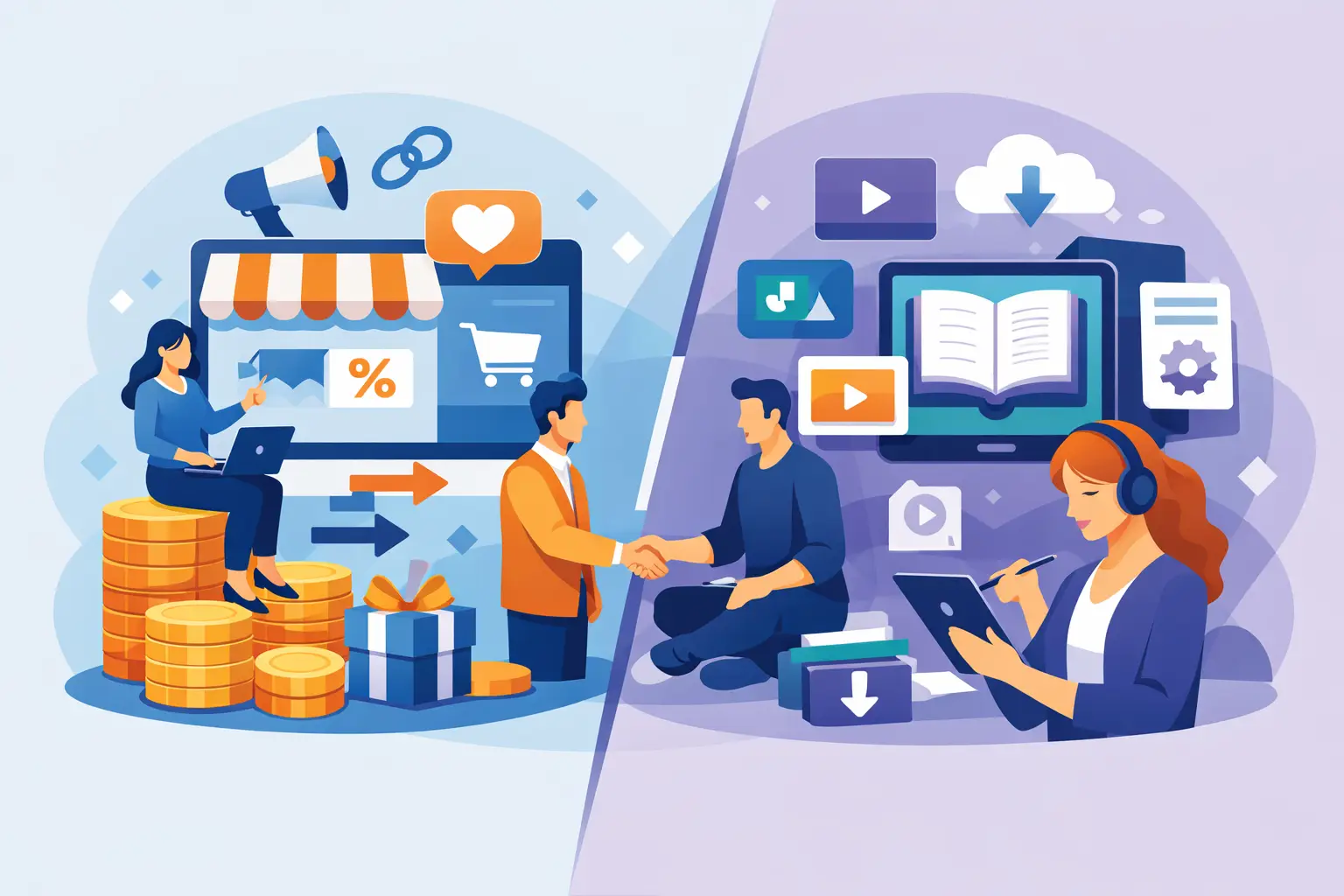
Most beginners get stuck before they make a dollar because they pick a business model based on hype, not fit. When you compare affiliate marketing vs digital products, the real question is simple: which one gets you to your first income faster without turning your life into a full-time tech project?
That matters more than most people realize. A model can look amazing on social media and still be a bad fit for someone who wants simple steps, low friction, and clear momentum. If you are starting from zero, the best option is not the one with the biggest upside on paper. It is the one you can actually launch, stick with, and improve without getting buried in confusion.
Affiliate marketing vs digital products: the real difference
Affiliate marketing means you promote someone else’s product and earn a commission when a sale happens through your referral. You are not building the offer, handling delivery, or dealing with customer support for the product itself. Your main job is marketing.
Digital products mean you sell a product you own or control. That could be a guide, template, mini-course, workshop, membership, or a done-for-you system. You keep more of the revenue per sale, but you also take on more responsibility because the product is yours.
On the surface, affiliate marketing sounds easier. You skip product creation. You do not need to build the thing you are selling. That is a real advantage.
But there is a catch. Since you do not control the product, pricing, customer experience, commission rate, or brand trust, your income depends heavily on traffic and conversions that you can influence but not fully control. You are borrowing someone else’s business.
With digital products, the setup can feel heavier at first, but the control is much better. You decide what the offer is, how it is positioned, what it costs, and how customers move through your system. That control can make growth simpler once the foundation is in place.
Which is easier for beginners?
If we are talking about pure setup, affiliate marketing usually wins. You can sign up for a program, get your link, and start promoting faster than you can build a product from scratch.
If we are talking about making beginner-friendly income with less long-term friction, digital products often win.
That sounds backward until you see what beginners struggle with. Most new people do not fail because they cannot get a link. They fail because they do not know how to stand out, what to say, how to build trust, or how to turn attention into sales. Affiliate marketing still requires those skills. In many cases, it requires them even more because you are selling an offer that many other people are promoting too.
A digital product can be harder to create if you are inventing everything yourself. But if you use a structured, beginner-friendly system that gives you the offer, the framework, and the direction, the game changes. You are no longer choosing between easy setup and better ownership. You can get both.
That is why a lot of beginners now lean toward simplified digital product models. They want an asset, not just a referral link.
Speed matters, but so does control
People often ask which model makes money faster. The honest answer is that either one can produce quick results if the offer is strong and the messaging is right.
Still, speed is not only about launching. It is also about how quickly you can fix what is not working. That is where control matters.
If an affiliate offer is not converting, your options are limited. You can change your content, your angle, your audience, or your traffic source. But you cannot usually change the product, checkout process, pricing, bonuses, or sales page.
With digital products, especially products you own or package under your own business, you can adjust the full path. You can simplify the promise, improve the product, test different price points, add support, bundle value, and strengthen the offer over time.
For a beginner, that flexibility is powerful. It means your business is not stuck waiting on someone else to improve theirs.
Profit margins and long-term upside
This is where digital products usually pull ahead.
Affiliate marketing pays a percentage. Sometimes that percentage is solid. Sometimes it is tiny. Either way, you are sharing the sale. That is fine if your volume is high and your traffic system is working. But if you are working hard to earn attention, lower margins can slow your growth.
Digital products typically give you much better margins because the cost to deliver them is low. Once the product exists, one sale does not usually add much extra cost. That means each sale can go further.
Higher margins create options. You can reinvest faster, test more content, improve your offer, and build a more stable income stream. You also have the chance to increase customer value over time with upgrades, bundles, or new products.
That does not mean affiliate marketing is weak. It can be a smart entry point if you want to learn promotion without creating anything first. It is just more dependent on outside platforms, outside offers, and outside rules.
Risk, trust, and simplicity
Both models have risk. They just have different kinds of risk.
With affiliate marketing, the biggest risk is dependency. A company can lower commissions, close a program, change the product, or shift the terms. If your income is tied to one offer, that can hurt fast.
With digital products, the bigger risk is execution. If you create something no one wants, poor sales are on you. If your offer is unclear, that is your problem to fix.
For beginners, trust is another major factor. People buy faster when the offer is clear, the transformation makes sense, and the message feels believable. A generic affiliate promotion can struggle if it sounds like every other pitch online. A focused digital product can build stronger trust because the offer is more specific and the brand experience is more consistent.
Simplicity matters too. Beginners do better when they are not juggling ten tools, five business models, and a hundred strategy videos. The simpler path is the one with fewer moving parts and clearer next steps. In many cases, that means using a done-for-you digital product system instead of trying to patch together a business from random advice.
Affiliate marketing vs digital products for side hustlers
If you have limited time, your model needs to work with your schedule, not against it.
Affiliate marketing can fit a side hustle because it removes product creation. You can focus on traffic, content, and promotion in small time blocks. That is useful if you want to start quickly and test the waters.
Digital products can fit even better if the product is already structured and the setup is streamlined. Instead of spending your nights hunting for products to promote, writing endless content with low control, and hoping for commissions, you can build around an actual offer you can keep improving.
That is a better foundation for people who want more than a few random sales. It gives you something you can grow into a real business.
A beginner-focused system like Simple Income System by @IronBear fits this shift well because it cuts down the hardest part for new people: figuring out what to sell and how to organize it. That kind of structure can shrink the gap between starting and earning.
So which one should you choose?
Choose affiliate marketing if you want the fastest entry, do not want ownership responsibility yet, and mainly want to practice promotion. It is a valid way to learn the basics and prove that people will buy through your content.
Choose digital products if you want more control, stronger margins, better long-term leverage, and a business you can shape as you grow. For most beginners who care about simplicity and income potential, this is usually the stronger move.
The smartest answer for some people is not either-or forever. It is starting where friction is lowest, then moving toward ownership as fast as possible. You can learn sales through promotion, but real momentum usually builds faster when you have an offer that belongs to you.
That is the key difference in affiliate marketing vs digital products. One helps you earn from someone else’s system. The other helps you build your own asset.
If your goal is quick beginner momentum, do not just ask which model is easier to start. Ask which one gives you a clearer path to control, profit, and repeatable growth. The model that feels simplest on day one is not always the one that pays off best by month three.
Leave a Reply